Google is quietly rewriting the rules on how your business shows up in search. In the last 90 days, it has removed reviews at record levels, fully retired Business Profile Short Names, and started sending account restriction emails that threaten total suspension. Most business owners found out by losing reviews they spent years earning.
This isn't routine maintenance. Google is rebuilding its Business Profile system to serve a new master: AI. Your profile is no longer just a listing humans browse. It's the primary data source that AI agents — Google's own and third-party — use to answer questions about your business. When someone asks a voice assistant “who's the best plumber near me,” the AI doesn't crawl your website. It reads your GBP.
That makes an incomplete, inaccurate, or policy-violating profile more dangerous than it has ever been. Not just for your search rankings — for your entire digital presence. If the AI can't trust your profile data, it won't recommend you. Period.
Here's what changed, why it matters, and exactly what to do about it before the next enforcement wave hits.
What Google actually changed
This wasn't a single announcement. Google rolled out multiple changes across late 2025 and early 2026, each one tightening the screws on Business Profile enforcement. Taken individually, they look like routine updates. Taken together, they represent a fundamental shift in how Google expects businesses to manage their online presence.
Google Review Enforcement Timeline
Updated review guidelines flagging gated and incentivized reviews
Machine-learning filters scanning reviews at scale
Thousands of legitimate reviews disappear without warning
Business owners receive restriction threats from Google
The review removals hit hardest. Business owners across industries — restaurants, medical practices, home service providers, retailers — woke up to find legitimate reviews gone. No notification. No explanation. Just a lower review count and a vague email warning of “potential account restrictions.”
The Short Names deprecation was quieter but signals the same direction. Google is cleaning house. Simplifying. Removing features that don't serve the AI-first future they're building. And businesses that aren't paying attention are getting caught in the cleanup.
What Changed and What to Do About It
Frozen for new creation/editing since June 2021; display removed Feb 2026, so any printed g.page/yourbusiness URLs will eventually break
→ Update all marketing materials with direct Maps links
Legitimate reviews disappearing without notice
→ Diversify review presence across platforms; screenshot reviews as backup
Automated flagging of incentivized or gated reviews
→ Stop all review incentive programs immediately
All profiles on the account suspended if flagged
→ Audit every profile for policy compliance today
Profiles with no recent activity may see ranking visibility decline and risk unverified status over time
→ Post updates regularly — practitioner guidance converges on at least twice a month
Your profile is now your AI resume
Here's what most coverage of these changes misses: Google isn't cleaning up Business Profiles for the sake of tidiness. They're cleaning them up because GBP data is the foundation of AI search. Google expanded Personal Intelligence within AI Mode to all US users in March 2026, pulling business information from profiles to generate answers grounded in a user's Gmail, Photos, and other connected context.
When the AI answers “who does emergency plumbing in Scottsdale,” it doesn't browse ten websites and compare them. It reads structured profile data — hours, services, reviews, photos, recent activity — and makes a recommendation. If your profile is incomplete, the AI has nothing to recommend. If your profile has policy violations, the AI has been told not to trust it.
How AI Agents Verify Your Business
Primary source of truth for AI agents
Machine-readable business attributes
Social proof validated by AI systems
Corroborating information for verification
Google also launched Business Agent, a conversational AI on Search that lets shoppers chat with a brand. Business Agent is trained primarily on Google Merchant Center product data rather than GBP, but the trust signals cross over: incomplete profiles and flagged reviews undercut the same credibility the agent leans on when deciding whether to surface your business at all.
Your Google Business Profile isn't a listing anymore. It's the dataset AI uses to decide whether to recommend you. Treat it accordingly.
What a fortified profile looks like
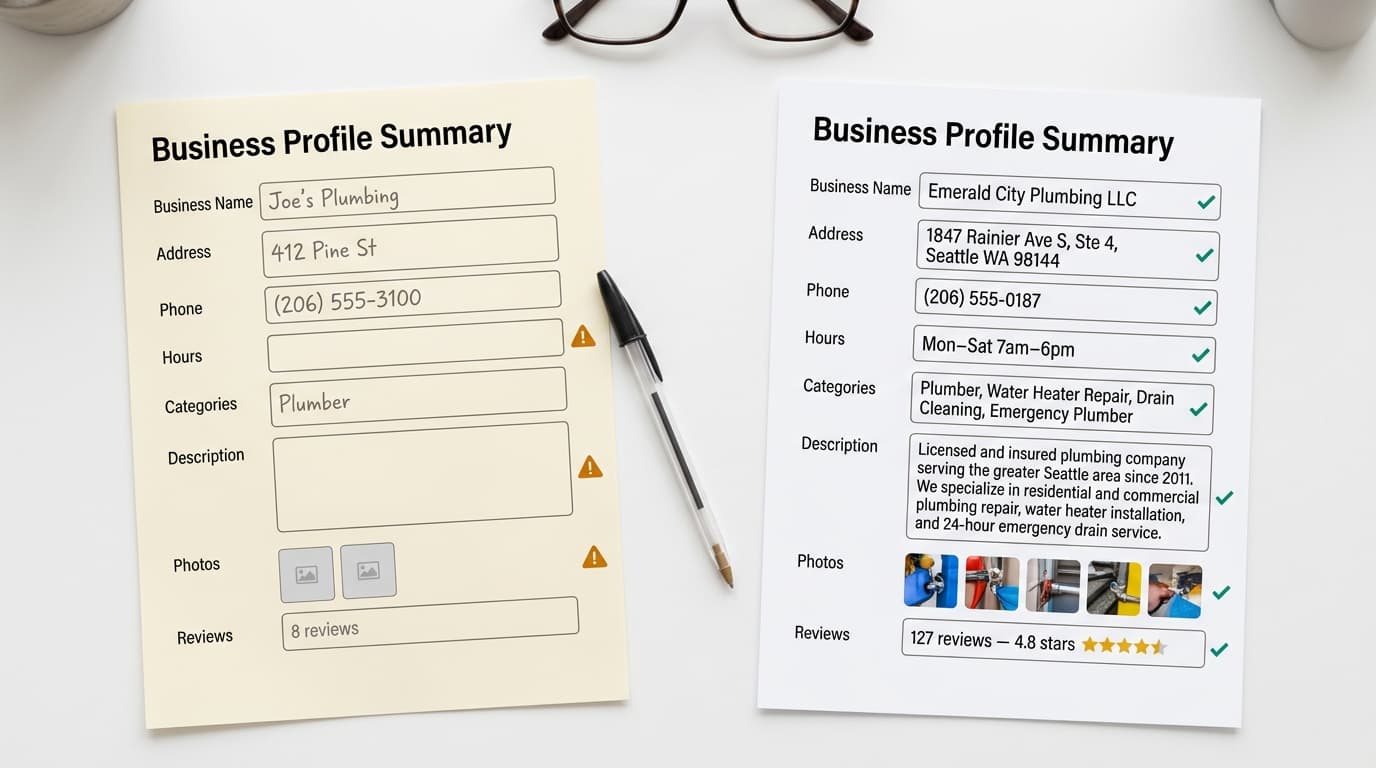
Most businesses fill out the basics — name, address, phone — and call it done. That was acceptable when GBP was just a local listing. In the AI era, every empty field is a gap the AI can't fill. And gaps mean lost recommendations.
The difference between a profile that gets recommended and one that gets skipped isn't subtle. It's the difference between 30% and 100% completeness. The good news: filling the gaps takes an afternoon, not a budget.
Profile Completeness Comparison
What we're doing about this at ShipsMind
We're treating Google Business Profile as critical infrastructure, not a set-and-forget listing. For every client we onboard, GBP audit and fortification is step one — before we touch their website, before we plan content, before anything else. Because if the AI can't find accurate data about your business, nothing else we build will reach its full potential.
Our audit covers every field Google exposes: primary and secondary categories, service areas, attributes, product listings, Q&A pre-population, and photo optimization. We also cross-reference GBP data against Schema.org markup on the website to ensure consistency — because AI agents check both, and conflicting information kills trust.
For reviews, we've shifted our guidance entirely. No incentive programs. No QR codes that gate reviews behind positive sentiment checks. Just direct, policy-compliant review requests and a system for responding to every review within 24 hours. The businesses that survive Google's enforcement wave are the ones that were doing it right all along.
We audit every client's GBP before we touch their website. Because if the AI can't find accurate data about your business, nothing else we build reaches its full potential.
Three things you can do this week
You can't control Google's enforcement decisions. You can control how prepared your profile is when the next wave hits.
Run a full profile compliance audit
2 hoursLog in to your Google Business Profile and check every section. Hours accurate? Description filled out? Categories include your secondary services? Photos recent and high-quality? Check your review history for any removals you weren't notified about. If you run incentivized review programs, stop them today — they're the primary trigger for the new AI detection.
First action: Open your GBP dashboard right now and count how many fields are empty or outdated. That number is your vulnerability score.
Update all marketing materials that reference Short Names
1–2 hoursSearch your website, email signatures, business cards, print materials, and social profiles for any g.page links. Replace them with direct Google Maps links to your business. While you're at it, update your website's LocalBusiness schema markup to include your Google Maps URL, ensuring AI agents can connect your website to your profile.
First action: Search your inbox for “g.page” to find everywhere you shared your old Short Name link.
Start a weekly profile update routine
15 minutes per weekProfile activity functions as a freshness signal. Post a photo of recent work, share a seasonal tip, or highlight a customer story. Respond to every new review within 24 hours — positive and negative. Answer questions in the Q&A section before random strangers answer them for you. Practitioner consensus: weekly cadence is where most businesses start seeing measurable movement.
First action: Take a photo of your workspace or a recent project right now. Post it to your GBP with a one-sentence caption. That's your first weekly update.
Common questions
Google rewrote the rules. Make sure your profile survives the next enforcement wave.
ShipsMind audits and fortifies Google Business Profiles as step one for every client. Complete data, policy-compliant reviews, consistent schema markup, and a maintenance system that keeps the AI informed. If your profile isn't ready for AI-powered search, we'll tell you exactly what's missing.
Get Your Free Profile AuditTakes 5 minutes. No pitch, no pressure. Just a clear picture of where your Google Business Profile stands — and what needs to change before the next wave of enforcement.