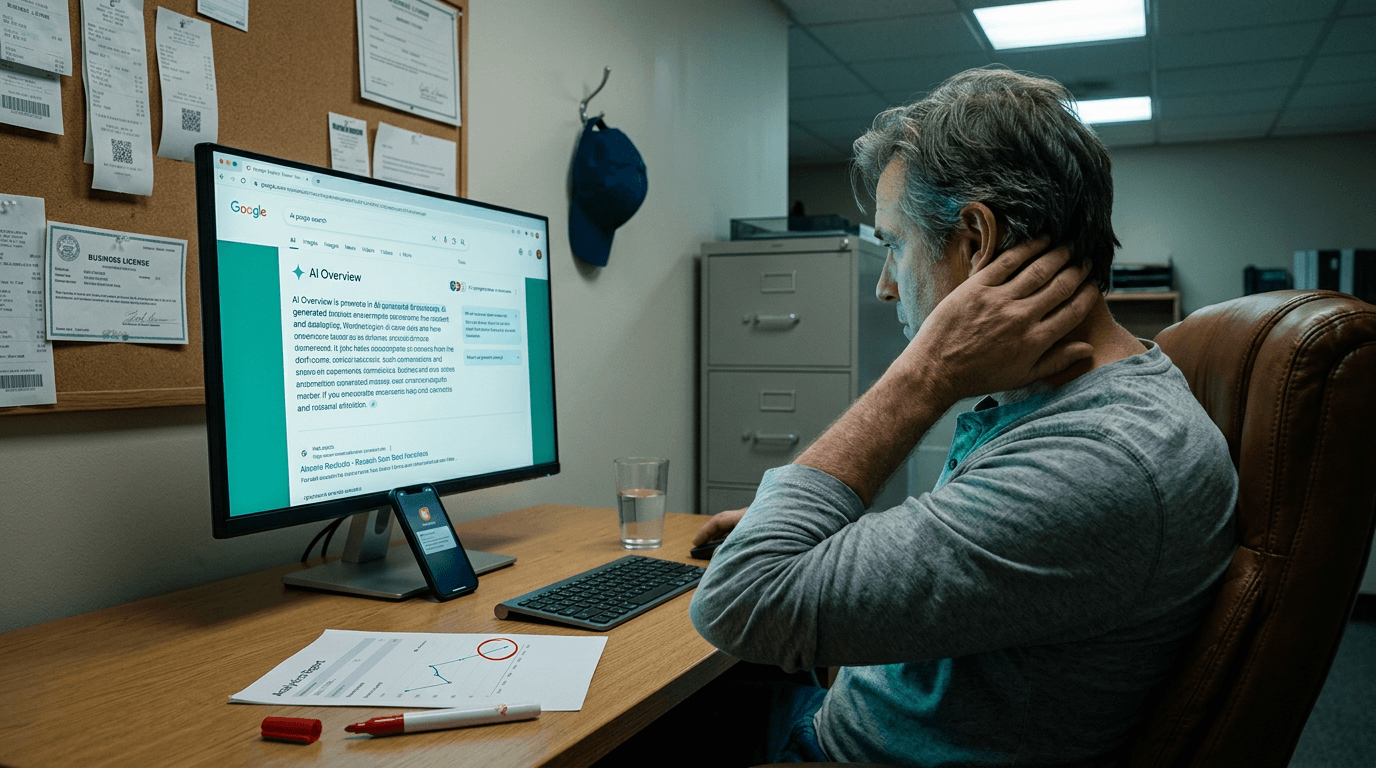
A year ago, Google AI Overviews appeared in roughly 31% of tracked queries. Today BrightEdge puts that number at 48%. Nearly half of every Google search now starts with an AI-generated summary sitting above the organic results you spent years optimizing for.
This isn't a gradual shift. BrightEdge's tracking went from 31% in February 2025 to 47% by August — most of the jump happened in six months, not twelve. And the query mix is moving too: Semrush found that commercial queries grew from 8.2% to 18.6% of AI Overview triggers between January and October 2025, while navigational queries jumped from under 1% to over 10%.
For small businesses, this changes the math. The strategies that worked when Google sent visitors to your website don't work the same way when Google answers the question itself. But there's a second side to this story: the businesses being cited as sources inside those AI summaries are seeing a new kind of visibility that didn't exist before.
The question isn't whether AI Overviews affect your business. They already do. The question is whether you're positioned to be the source they cite — or the result they push below the fold.
The number that changed the game
When Google first rolled out AI Overviews in May 2024, the coverage was narrow. Mostly informational queries — “how does photosynthesis work” and “what is a 401k.” Easy to ignore if you ran a local business or sold services.
That changed fast. Google expanded AI Overviews into commercial queries, product comparisons, and service-related questions — the queries that sit closest to a customer's purchase decision.
AI Overviews: Share of Tracked Queries (BrightEdge)
At 48%, AI Overviews aren't an edge case anymore. They're the default experience for nearly half of everything people search. And the number keeps climbing.
The query mix is shifting fast
In January 2025, AI Overviews were almost entirely an informational feature — 91% of the queries that triggered them were things like “how does X work” or “what is Y.” By October, that had dropped to 57%, not because Google pulled back on informational queries, but because the denominator grew. AI Overviews expanded into commercial, navigational, and transactional territory.
That's the part most business owners miss. The AI Overview you see on “what is a 401k” is the same feature that now increasingly appears on “best CRM for small teams” or “X vs Y” — the exact queries your customers use right before they buy.
Where AI Overviews Now Appear (Semrush, Jan → Oct 2025)
Share of AI Overview queries by intent. Source: Semrush AI Overviews Study
Informational AI Overviews are the noisy part. The quieter story is that they're now showing up on commercial and navigational queries — the searches closest to a purchase decision.
The search page you optimized for is gone
The mental model most businesses have of Google — ten blue links, position one gets the most clicks, SEO gets you there — is increasingly disconnected from reality. When an AI Overview appears, it occupies the entire above-the-fold space. Organic results get pushed down, often below an ad or two as well.
The result: even if you rank #1 organically, the searcher might never scroll to see you. They got their answer from the overview, or they clicked one of the cited sources within it. Your beautiful ranking is invisible below the fold.
What the Search Page Looks Like Now
Traditional Results
10 blue links. Position 1 CTR fell from 28% to 19% as AIOs scaled.
AI Overview Results
AI answers first. Organic pushed below the fold.
But here's the part most coverage misses: AI Overviews cite sources. They link to the websites they pulled information from. And being one of those cited sources is a form of visibility that's arguably stronger than a traditional organic listing — because the AI has effectively endorsed your content as authoritative.
What actually works in the AI Overview era
AI Overviews favor content with specific properties: directly answers a question, comes from an authoritative source, provides clear and factual information, and is structured in a way the AI can extract cleanly. This favors a different kind of content than traditional SEO did.
The old playbook — write 2,000 words targeting a keyword, build backlinks, wait for rankings — still has value. But the new playbook adds a layer: make your content the most extractable, most authoritative, most clearly structured answer to the specific question the searcher is asking.
The Content Strategy Shift
Optimizing for Rankings
- —Keyword density and exact-match targeting
- —Long-form content for word count
- —Link building as primary strategy
- —Ranking position as the key metric
- —Content designed to attract clicks
Goal: get the click. Measure: rank position.
Optimizing for AI Citation
- ✓Direct answers to specific questions
- ✓Concise, factual, well-structured content
- ✓Structured data and schema markup
- ✓Brand mentions and citation rate as metrics
- ✓Content designed to be the authoritative source
Goal: be the cited source. Measure: brand visibility.
Think about it from Google's perspective. The AI needs to synthesize an answer from multiple sources. It gravitates toward content that states things clearly, backs them up with specifics, and is structured with semantic HTML and schema markup. If your page reads like marketing copy, the AI will skip it for a competitor's page that reads like an answer.
What we're doing about this at ShipsMind
Every piece of content we produce is built for dual readership: humans who need to understand and be persuaded, and AI systems that need to extract, verify, and cite. We structure content with FAQ schema, how-to markup, and clear heading hierarchies that make extraction straightforward.
For our clients, we audit existing content through the lens of AI citability. Which pages answer specific questions directly? Which ones bury the answer under three paragraphs of introduction? We restructure content so the answer leads, the evidence follows, and the structured data connects it all.
We also monitor AI Overview presence for client keywords — tracking whether they're being cited, how often, and what content is winning the citation. This is new territory, and the businesses measuring it now are the ones who will own it in 12 months.
We build content for dual readership — humans who need to be persuaded and AI systems that need to extract and cite. That's the new baseline.
Three things you can do this week
You can't control whether AI Overviews appear. You can control whether you're the source they cite.
Audit your top 20 keywords for AI Overview presence
Search your most important keywords in incognito mode. For each one, note whether an AI Overview appears and who's being cited. If your competitors are showing up in overviews and you're not, you know exactly which content to prioritize.
First action: Search your primary service + your city right now. Screenshot the result. That's your baseline.
Restructure one key page for AI extractability
Pick your most important service page. Rewrite it so the answer to “what does this business do?” appears in the first two sentences. Add FAQ schema for the three questions your customers ask most. Use clear heading hierarchy (H2 for questions, content directly below). Add LocalBusiness and Service schema markup.
First action: Read your service page out loud. If the first paragraph doesn't directly state what you do, where you do it, and who it's for — rewrite it.
Start measuring brand visibility, not just rankings
Set up a Google Alert for your business name. Track how often your brand appears in AI-generated contexts — not just your rank position. Tools like SEMrush now show AI Overview tracking. The metric that matters is shifting from “position 1” to “cited in overview.”
First action: Google your business name. Does the AI Overview mention you? If not, check what it mentions instead — that's your competitor and your benchmark.
Common questions
Google's AI is already answering your customers' questions. Make sure it's citing you.
ShipsMind builds content systems designed for dual readership — humans who need to be convinced and AI systems that need sources to cite. Structured data, extractable content, and measured visibility in the AI era. If your competitors are showing up in AI Overviews and you're not, that's the gap we close.
Audit Your AI VisibilityTakes 5 minutes. No pitch, no pressure. Just a clear picture of where your business stands in the AI Overview landscape — and what it takes to become the source Google cites.