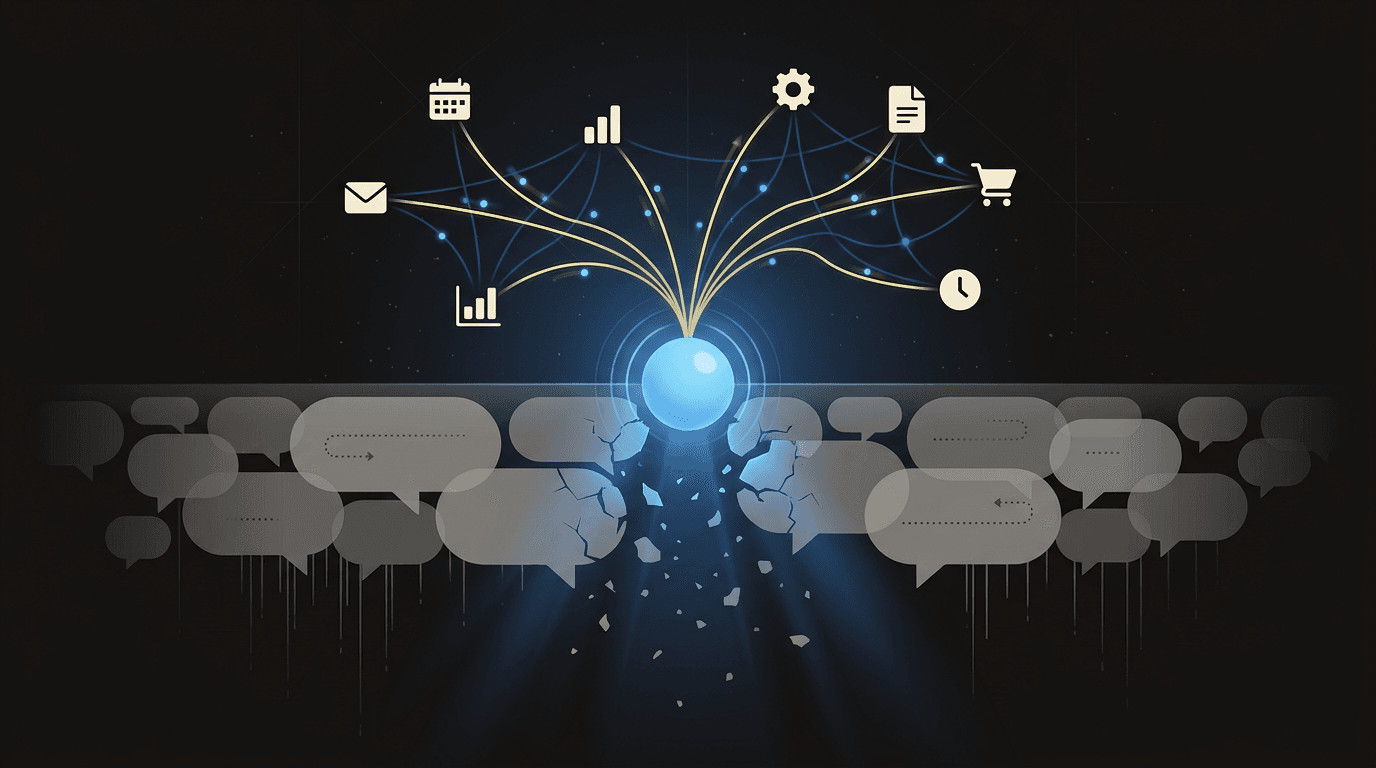
You probably tried a chatbot last year.
Maybe it answered a few customer questions. Maybe it generated some social media captions. Maybe it sat in the corner of your website like an intern with nothing to do.
That was AI in 2024.
Here's what's happening now: AI isn't just talking anymore. It's doing. Reordering inventory when stock runs low. Following up with leads who went quiet. Reconciling invoices at 2 a.m. while you sleep.
The shift from chatbots to AI agents is the biggest change in business technology since cloud computing moved your files off a hard drive. And most small businesses haven't heard it's happening.
Why chatbots disappointed
Let's be honest about what happened.
Businesses spent money. Installed a chat widget. Watched it answer the same three questions their FAQ already covered. Then quietly stopped talking about their “AI initiative.”
The problem wasn't the technology. It was the job description.
Chatbots are receptionists. They greet people. They point to the right room. That's useful, but it's not transformative. You didn't hire AI to greet people — you hired it to get work done.
You didn't hire AI to greet people — you hired it to get work done.
Think of it this way. If you hired someone and all they did was answer questions when people walked through the door, you'd be frustrated. You'd want them restocking shelves, following up with customers, updating the books, placing orders.
That's the gap between a chatbot and an agent.
A chatbot waits for input and responds. An agent monitors conditions, makes decisions, and takes action — across multiple tools, without you standing over its shoulder.
From “Ask Me Anything” to “I'll Handle It”
“Agentic AI” sounds like something from a whitepaper. The concept is simple.
An AI agent is software that can:
That third part is what changed. Chatbots could perceive and sort-of decide. Agents actually do the thing.
Chatbot vs Agent
Reactive
Autonomous
This isn't hypothetical
In early 2025, GoDaddy launched Airo.ai — an AI agent that doesn't just suggest website designs. It builds websites, generates logos, writes copy, and registers domains. Autonomously. For the 21 million small businesses on their platform.
That's not a chatbot answering “how do I build a website?” That's an agent building the website.
Gartner projects that by the end of 2026, around 40% of enterprise applications will include task-specific AI agents — up from under 5% at the start of 2025. The enterprise world is moving fast. But here's what they won't tell you: the tools that power these agents are already accessible to businesses with five employees, not just five thousand.
What agents actually do
Forget the hype. Here's what agents are doing right now for businesses the size of yours.
Accounts Receivable
Lead Follow-Up
Inventory Management
Customer Onboarding
Compliance Reporting
Accounts receivable. An agent monitors your invoicing system. When a payment is 7 days overdue, it sends a follow-up email from a template you approved. At 14 days, it escalates to a firmer template and flags it in your dashboard. No one on your team touches it.
Lead follow-up. A prospect fills out your contact form at 11 p.m. By 11:01 p.m., an agent has sent a personalized response, added them to your CRM, tagged them by inquiry type, and scheduled a follow-up task for your salesperson the next morning.
Inventory management. An agent watches stock levels across your catalog. When any SKU drops below your threshold, it drafts a purchase order, routes it for approval, and sends it to your supplier — before you've finished your morning coffee.
Customer onboarding. A new client signs a contract. Within minutes, an agent sends the welcome email, creates their account in your project management tool, schedules the kickoff call, and generates the onboarding checklist.
Compliance reporting. End of month. An agent pulls data from your accounting software, formats it against reporting requirements, flags anomalies, and drafts the report. Your accountant reviews and submits. What used to take a full day takes an hour.
Agents don't just save time. They eliminate the gaps where work falls through the cracks.
The numbers behind the shift
The adoption curve is steep.
Industry surveys suggest roughly half of small businesses now use AI in some form — up from around one in seven just two years ago. Among businesses with 10 to 100 employees, the figure is closer to two-thirds.
But here's the uncomfortable part: most of that adoption is still chatbots, content generation, and basic automation. Fewer than one in five SMBs have moved into agentic workflows — agents that independently execute multi-step business processes.
That means the businesses that make this jump now don't just adopt AI. They leapfrog their competition.
SMB AI Maturity
Chatbots & Content
2023–2024Q&A bots, content generation, basic templates
Smart Automation
2024–2025Connected workflows with human approval gates
Autonomous Agents
2025+AI that monitors, decides, and acts independently
Meanwhile, the smallest businesses — those with fewer than five employees — remain on the sidelines. Research suggests roughly four in five still believe AI isn't applicable to their business. They're wrong — and the FAQ below explains why.
How ShipsMind approaches agentic AI
We don't sell AI agents off a shelf. That approach fails for the same reason chatbots failed — technology without context is expensive noise.
Process audit
Week 1We map your existing workflows — not your wishlist, your reality. Where does work get stuck? Where do things fall through cracks? This identifies the 2–3 processes where an agent would have the highest immediate impact.
Agent design
Week 2We design the agent's decision logic, triggers, and actions. You see exactly what it will do before we build it. No black boxes. Every rule is something you'd explain to a new hire — because that's essentially what we're doing.
Build and integrate
Weeks 3–4We connect the agent to your existing tools — CRM, email, accounting software, project management. We use platforms like Make, Zapier, and custom integrations where needed. Nothing gets ripped out and replaced.
Supervised rollout
Weeks 4–6The agent runs with human approval gates. Every action gets reviewed for the first two weeks. We tune the rules based on real performance. Only when you're confident does the leash come off.
Monitor and expand
OngoingOnce one agent is running smoothly, we identify the next process. Most clients have three to five agents running within six months.
Three things you can do this week
You don't need to hire anyone to start. Here's where to begin.
Audit one repetitive process
Pick the task your team complains about most. Write down every step, every decision point, every system involved. If it follows the same pattern more than 80% of the time, it's a candidate for an agent.
First action: Open a document and write “When [trigger], then [action]” for that process. If you can describe it in those terms, an agent can probably do it.
Try a no-code agent builder
Create a free account on Make.com or Zapier. Build a simple two-step automation — “when a form is submitted, create a row in a spreadsheet and send a confirmation email.” This isn't an agent yet, but it's the foundation.
First action: Go to Make.com, click “Create a scenario,” and connect your email to a spreadsheet. Working automation in under an hour.
Map your agent-ready processes
List every process that follows a predictable pattern. Sort by two criteria: how often it happens and how much time it consumes. The one that scores highest on both is your first agent candidate.
First action: Create a spreadsheet with three columns — Process, Frequency (daily/weekly/monthly), Time Per Occurrence. Fill in your top ten tasks. The winner will be obvious.
Common questions
The gap between chatbot businesses and agent businesses compounds every month.
You don't need to overhaul your tech stack or hire an engineering team. You need to identify the right process, build the right agent, and start compounding that advantage now. We'll help you find the first one.
Find Your First AI Agent OpportunityA 30-minute call. We'll identify the one process where an agent would have the biggest impact — and map exactly what it would take to build it.